
Rating: 4.3 / 5 ★★★★☆
Tower Rush from Galaxsys takes a familiar crash game format and adds a layer most competitors skip: the player builds the tower themselves. Block by block, floor by floor, with a cashout button available at every stage. The RTP of 96-97% places it above most crash games on the market. Three random bonuses add unpredictability. No auto-cashout means every decision is manual, which is simultaneously the game’s strongest feature and its biggest demand on the player.
Every crash game comes down to one question: when do you cash out? On most crash games, that question lives in isolation. You watch a number climb, you click a button, the round ends. Tower Rush asks that same question but wraps it inside something more complex. Before you decide when to cash out, you have to successfully place a block. And another. And another. Each successful block raises the multiplier and makes the cashout decision harder, because walking away from x6 feels wasteful when x8 is just two floors away.
That tension between building higher and cashing out is the core of the game. Not the block-stacking mechanic. Not the bonuses. The moment where you look at a multiplier and decide whether the next floor is worth the risk. This guide focuses on that decision and everything surrounding it.
How a Tower Rush round unfolds from bet to payout
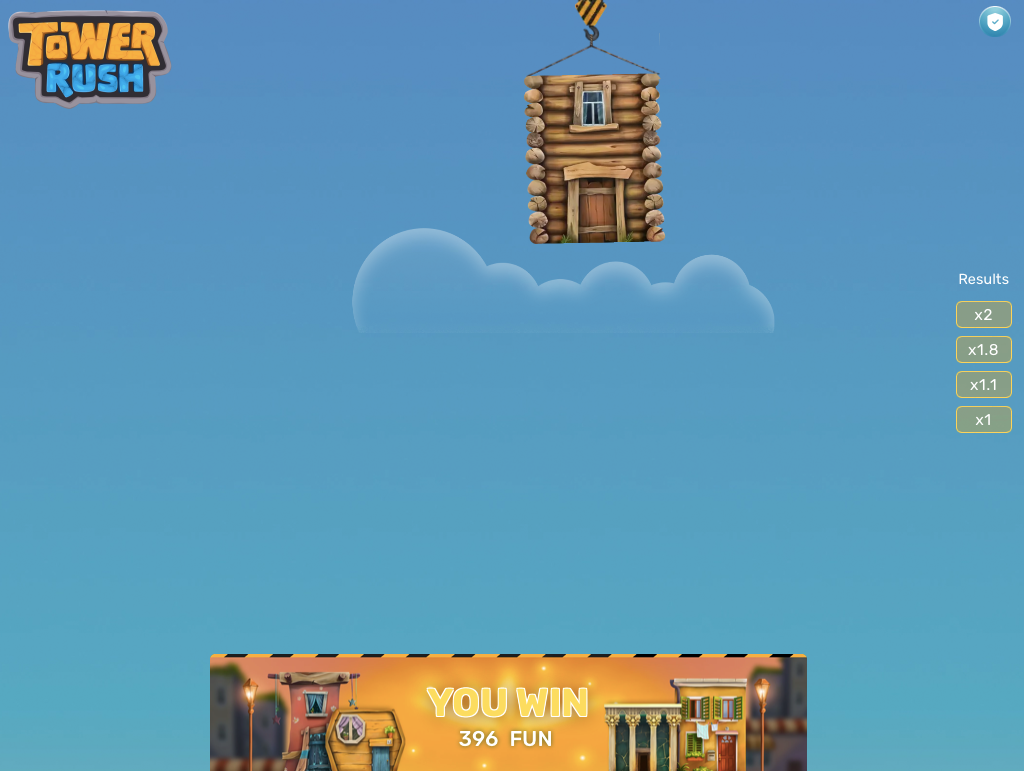
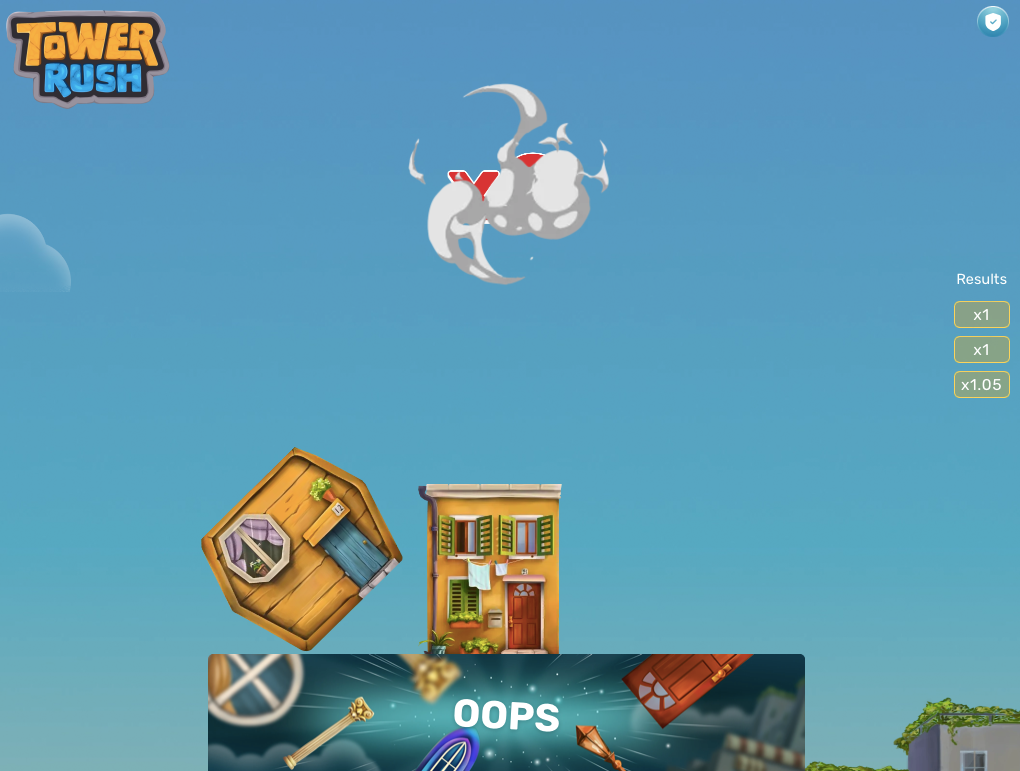
The player sets a stake between €0.01 and €100. A block appears on a crane and swings horizontally. Clicking releases the block. If it lands on the tower, a new floor is added and the multiplier increases. If it misses, the tower collapses and the round ends with zero return.
Cashout activates after the first successful block. One click secures the current multiplier. No minimum floor requirement. You can walk away at x1.2 if you want. Most players don’t, which is where the interesting part begins.
Floors one through four are relaxed. The block moves slowly, the tolerance is generous, and nearly every click lands. Floors five through seven shift the dynamic. The swing widens, the speed picks up, and clicks that would have been fine on floor three miss on floor six. From floor eight onward, every drop demands genuine concentration. The margin for error shrinks to a point where even experienced players miss regularly.
Round duration depends entirely on the player. A cautious approach with cashout at x3 takes about fifteen seconds. Building to x10 or higher takes ninety seconds to two minutes. The game doesn’t rush you. The pressure comes from the multiplier growing and the difficulty increasing, not from a timer.
Tower Rush and the cashout dilemma
The cashout decision on Tower Rush carries more weight than on a standard crash game. On Aviator, the multiplier climbs passively and the player clicks one button. The emotional cost of cashing out is limited because the player hasn’t invested any effort beyond the initial bet. On Tower Rush, by the time the multiplier reaches x6, the player has successfully placed six blocks. Each block required focus and timing. Walking away feels like abandoning work already completed.
Behavioural psychology calls this escalation of commitment. The more effort invested in a round, the harder it becomes to stop. At x4, the player thinks “one more floor.” At x6, “just two more and I’ll hit x8.” At x8, “I’ve come this far, x10 is right there.” Each step feels smaller than it is, because the brain measures distance in floors (one or two) rather than in probability of success (which drops dramatically with each floor).
Chris W. – Bristol, January 2026 – ★★★★☆ (4/5)
“My biggest lesson after two weeks: the hardest part of Tower Rush isn’t the block timing. It’s pressing the cashout button when every instinct tells you to keep going. I set x5 as my target before each round and force myself to stick to it. My sessions became way more stable.”
Players who achieve the most consistent results share one trait: they set a cashout target before the round starts and don’t renegotiate during play. The target floor is fixed. No “just one more.” This discipline sounds trivial. In practice, it’s the single hardest element of the game.
A second factor compounds the cashout dilemma: loss aversion. A player who cashes out at x5 and then imagines they could have reached x10 experiences regret. That regret is disproportionately strong compared to the satisfaction of securing a fivefold return. In the next round, the player raises their target to avoid “missing out.” Result: more failures, because higher floors have lower success rates.
Three session profiles and what they produce
After tracking twenty sessions across different approaches, three distinct profiles emerged. None of them “beats” the house. The mathematical edge (3-4% at 96-97% RTP) is constant. These profiles differ only in the shape of the experience.
| Profile | Cashout target | Approx. success rate | Rounds per €30 budget | Feel |
|---|---|---|---|---|
| Conservative | x3 consistently | ~70-75% | 50-80 | Steady, low drama |
| Balanced | x5-x6 | ~50-60% | 30-50 | Alternating wins and losses |
| Aggressive | x10+ | ~25-35% | 15-30 | Fast losses, occasional big hits |
The conservative profile maximises playtime. Sessions are predictable, with small gains and small losses. The aggressive profile compresses everything: the budget can vanish in ten minutes, but a single successful cashout at x12 or x15 reverses the session’s balance sheet. The balanced profile sits in between, offering a mix of tension and stability.
🎮 Start Tower RushA practical takeaway from this table: a player with a €30 budget and a conservative approach (€0.50 stake, x3 cashout) can play for an hour or more. The same budget with an aggressive approach (€2 stake, x10+ target) lasts fifteen to thirty minutes. The profile choice determines not just the odds of hitting a high multiplier, but also how long the entertainment lasts.
Pattern observed: Many players migrate from aggressive to conservative over time. The initial excitement of chasing high multipliers gives way to an appreciation for longer, calmer sessions. This shift usually happens after the second or third time the budget disappears in under fifteen minutes.
Bonuses through the lens of the cashout decision
Tower Rush’s three bonuses (Frozen Floor, Temple Floor, Triple Build) don’t exist in isolation. They interact directly with the cashout decision, and that interaction is where their real impact lies.
Frozen Floor locks the current multiplier as a guaranteed payout. This removes the downside from continuing to build. Without Frozen Floor, every additional floor puts the entire stake at risk. With it, the worst outcome is receiving the frozen amount. The practical effect: almost every player who receives Frozen Floor continues building higher than they normally would. The bonus changes behaviour before the player consciously decides to change strategy.
Triple Build places three floors automatically with no risk. The multiplier jumps, and the player regains control at a higher level than they reached on their own. This bonus is the most valuable in expected terms because it eliminates risk on three consecutive floors. Temple Floor spins a wheel with multiplier segments. Random outcome, no player input.
Laura H. – Glasgow, February 2026 – ★★★★★ (4.5/5)
“Frozen Floor at x9. I built to x16. Normally I’d never go past x7. That one bonus made the entire session profitable. But the next day, no bonuses at all, and the session was completely flat. You can’t plan around bonuses. They’re random.”
The key insight about bonuses: they can account for 30-60% of a session’s total profit. Planning your budget assuming bonuses will appear is a mistake. Planning it assuming they won’t gives a more realistic baseline.
Demo mode: calibration before commitment
Tower Rush’s demo version requires no registration and no deposit. Same mechanics, same bonuses, same difficulty curve. Virtual credits replenish automatically. The game runs in HTML5 across all devices.
Three uses of demo that matter most. First: identifying your personal ceiling. The floor where errors start multiplying is different for every player. Ten to fifteen rounds reveal this floor clearly. Second: calibrating your cashout target. Playing ten rounds at x4, ten at x7, and ten at x10, while tracking success rates, provides hard data on where your comfort zone ends. Third: warming up after a break. Players returning after several days benefit from five to ten demo rounds before switching to real money. The timing recalibration is real and measurable.
Mobile versus desktop makes a genuine difference. Mouse clicks offer millimetre-level precision. Thumb taps on a six-inch touchscreen don’t. Tested on a Samsung Galaxy A54 and iPhone 14: game performance was identical on both, but accuracy on floors eight and above dropped noticeably on mobile compared to desktop. Players who primarily play on their phone should set their cashout target one to two floors lower than what they’d aim for on a computer.
One thing demo can’t replicate: the psychological weight of real money. A player who calmly cashes out at x5 in demo may hesitate and push to x7 when real stakes are involved. Knowing this gap exists is half the battle.
What the RTP means in practice
Tower Rush’s RTP ranges from 96.12% to 97%. Compared to most crash games (94-96%) and the average online slot (93-96%), this places it in the upper tier. Aviator offers 97%, Spaceman 96.50%. Tower Rush is competitive.
But RTP is a theoretical number calculated over hundreds of thousands of rounds. On a twenty-minute session with fifteen to twenty rounds, variance is the dominant force. Two sessions with identical strategy can produce opposite outcomes. A player who wins €20 on Monday and loses €25 on Tuesday hasn’t experienced a change in the game. They’ve experienced normal variance.
Variance correlates with cashout strategy. Conservative players (x3-x4 target) experience smaller swings. Aggressive players (x10+ target) experience wild swings. The RTP doesn’t change. The ride does.
Galaxsys certifies the game with an independent RNG and Provably Fair protocol. Every round’s outcome is linked to a cryptographic hash verifiable by the player after the round ends. Audits by iTech Labs and eCOGRA provide additional oversight. The fairness is not a matter of trust but of cryptographic verification.
Getting started with real money
Real money play requires an account at a licensed online casino that offers Tower Rush. The game is available on over a hundred platforms with licenses from the Malta Gaming Authority, Curaçao eGaming, or Gibraltar. Registration is standard: name, email, date of birth, email verification. Five minutes from form to first deposit.
Deposit methods depend on the casino: Visa, Mastercard, Skrill, Neteller, bank transfer, and cryptocurrencies. Minimum deposit typically €10-20. Credits appear instantly for cards and e-wallets.
First withdrawal triggers identity verification (KYC): government-issued ID plus proof of address from the last three months. Processing times after verification: e-wallets a few hours to 24 hours, cards one to three business days, bank transfers three to five business days, crypto two to six hours.
Before depositing, check the casino’s withdrawal terms. Weekly limits, processing fees, and minimum withdrawal amounts vary significantly between platforms. A casino with fast deposits but slow or limited withdrawals creates friction that isn’t immediately visible.
First session framework: Deposit €50. Stake €1.50 per round (3% of balance). Cashout target x5. Budget limit: €50 or twenty rounds, whichever comes first. This structure leaves room for a series of losses without panic and establishes a rhythm before the player adjusts their approach.
🎮 Win With Tower RushTower Rush compared to Aviator and Spaceman
All three are crash games. The similarities end there.
| Feature | Tower Rush | Aviator | Spaceman |
|---|---|---|---|
| Player role | Active (builds blocks) | Passive (watches multiplier) | Passive (watches multiplier) |
| RTP | 96.12 – 97% | 97% | 96.50% |
| Auto-cashout | No | Yes | Yes |
| In-round bonuses | 3 (Frozen Floor, Temple Floor, Triple Build) | None | None |
| Other players visible | No | Yes | Yes |
| Mental fatigue | High (active mechanic) | Low | Low |
Aviator and Spaceman are for players who want to set a strategy and observe. Tower Rush is for players who want every click to count. The active mechanic creates a feedback loop that passive crash games lack: the player’s performance directly affects how high the multiplier can go. This feedback loop is why Tower Rush generates more engagement per round but also more fatigue per session.
The absence of auto-cashout on Tower Rush is the clearest dividing line. Players who value the “set it and forget it” approach will be happier with Aviator. Players who want to feel the weight of every decision will find that in Tower Rush. Neither preference is wrong. They’re different types of entertainment.
Responsible play and knowing when to stop
Tower Rush is a fast game with an active mechanic. Both characteristics promote overplay. Rounds last seconds. Mental fatigue after fifteen to twenty minutes degrades decision quality. The “one more round” impulse is strong because each round feels brief and inconsequential, even though ten of them add up quickly.
Signs that a session should end: increased errors on floors that weren’t a problem earlier, cashout decisions made reflexively rather than deliberately, the desire to raise stakes after a lost round, frustration replacing enjoyment. Each of these is a signal, not a suggestion.
The house edge is permanent. Experience, reflexes, and hot streaks don’t reduce it. Tower Rush is entertainment. When the line between entertainment and compulsion blurs, the correct response is to close the game.
An underappreciated advantage of Tower Rush’s format: the active mechanic functions as a natural brake. On a slot, a player can spin for an hour without cognitive effort. On Tower Rush, the brain signals exhaustion through rising error rates. Heeding that signal rather than fighting it protects the bankroll and preserves the game’s enjoyment for the next session.
Support: GamCare – 0808 8020 133 (UK). BeGambleAware – www.begambleaware.org. National Council on Problem Gambling – 1-800-522-4700 (US).
Three quick questions about Tower Rush
Does Tower Rush require a download?
No. The game runs in HTML5 directly in the browser on desktop, iOS, and Android. No app, no installation.
Can bonuses be triggered deliberately?
No. Frozen Floor, Temple Floor, and Triple Build appear randomly, each once per session maximum. There is no way to influence when or whether they appear.
What happens if I lose connection mid-round?
The outcome depends on the casino’s policy. Most licensed platforms will either complete the round automatically or return the stake. Check the specific casino’s terms before playing on unstable connections.
🎮 Play Now